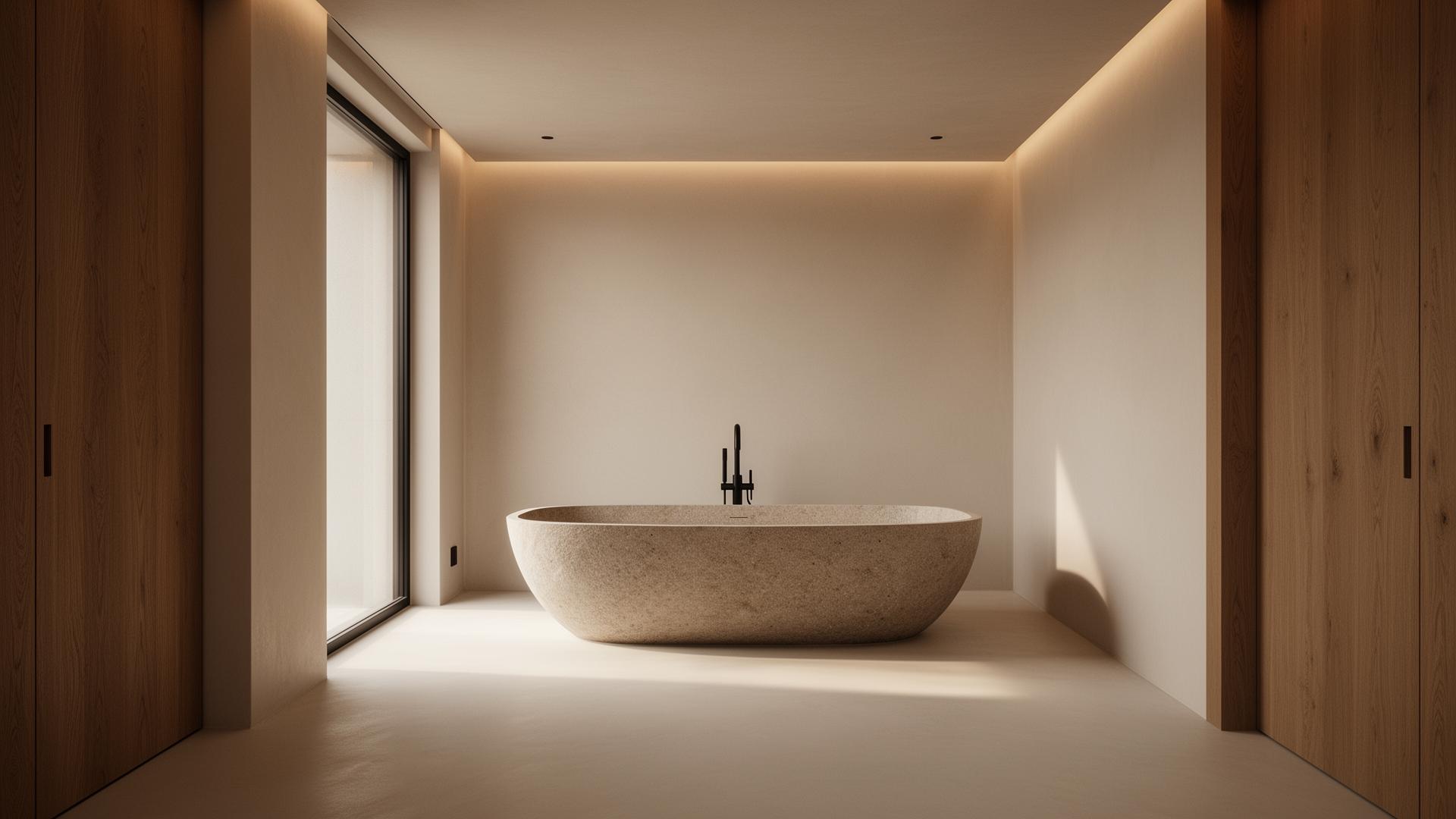
Everything Central Coast homeowners, designers and architects need to know about specifying, costing and caring for a seamless microcement bathroom.
01
Why microcement is the bathroom of the moment
Microcement bathrooms feel quiet. Without tiles or grout, the room reads as a single, hand-finished volume of warm mineral stone. The eye is drawn to the architecture, the light and the joinery rather than to grid lines and silicone joins.
For Central Coast homes that lean toward considered, coastal-luxury interiors, microcement is the finish that most consistently delivers the spa-style outcome clients are asking for.
02
Where microcement works in a bathroom
Floors, walls, ceilings, shower bases, niches, vanity tops, integrated basins, baths, hobs and skirtings can all be finished in microcement — usually in a single colour, sometimes in two tones to define wet and dry zones.
The system wraps around joinery, steps and curves, allowing fluid forms that tile and stone cannot achieve without joints.
03
Waterproofing and the Mineral Fox / Mineral Fox system
Every microcement bathroom we install is engineered as a complete Mineral Fox / Mineral Fox wet-area system — Australian-Standard waterproofing membrane, primer, fibreglass mesh in stress areas, base coats, finish coats and high-performance protective sealers.
It is the system, not just the finish coat, that makes the bathroom waterproof and durable. Cutting corners on any layer compromises the whole.
04
Cost, lead time and what drives the budget
Microcement bathrooms are a premium finish, broadly comparable to high-end tiling once labour, waterproofing and waste reduction are accounted for. Drivers include bathroom size, complexity of niches and joinery, substrate condition and colour selection.
From sign-off, a typical Central Coast microcement bathroom takes 2–3 weeks on site for the finish itself, plus any base building works. Fixed quotes are issued after a site consultation.
05
Caring for a microcement bathroom
Day-to-day, warm water and a pH-neutral cleaner is all that is required. Avoid abrasive pads and acidic or bleach-based cleaners. We provide a written care guide on handover and recommend resealing every 5–7 years to keep the finish performing at its best.